Global event search
Adjacent global lunar eclipse peaks
Nearest: Partial lunar eclipse
43 days, 19 hours, 46 minutes before the selected instant
Previous peak
Partial lunar eclipse
28 Aug 2026, 04:12 UTC
Check the Moon near peak from your location
- P1
- U1
- Peak
- U4
- P4
- Penumbral phase
- Friday, 28 August 2026 at 01:23 to Friday, 28 August 2026 at 07:02 (338 minutes)
- Umbral phase
- Friday, 28 August 2026 at 02:33 to Friday, 28 August 2026 at 05:52 (199 minutes)
- Totality
- Not reached in this eclipse
Next peak
Penumbral lunar eclipse
20 Feb 2027, 23:12 UTC
Check the Moon near peak from your location
- P1
- Peak
- P4
- Penumbral phase
- Saturday, 20 February 2027 at 21:11 to Sunday, 21 February 2027 at 01:13 (242 minutes)
- Umbral phase
- Not reached in this eclipse
- Totality
- Not reached in this eclipse
Check which eclipse stages are visible from your location
Annual calendars: 2026 lunar eclipses · 2027 lunar eclipses
Shadow key
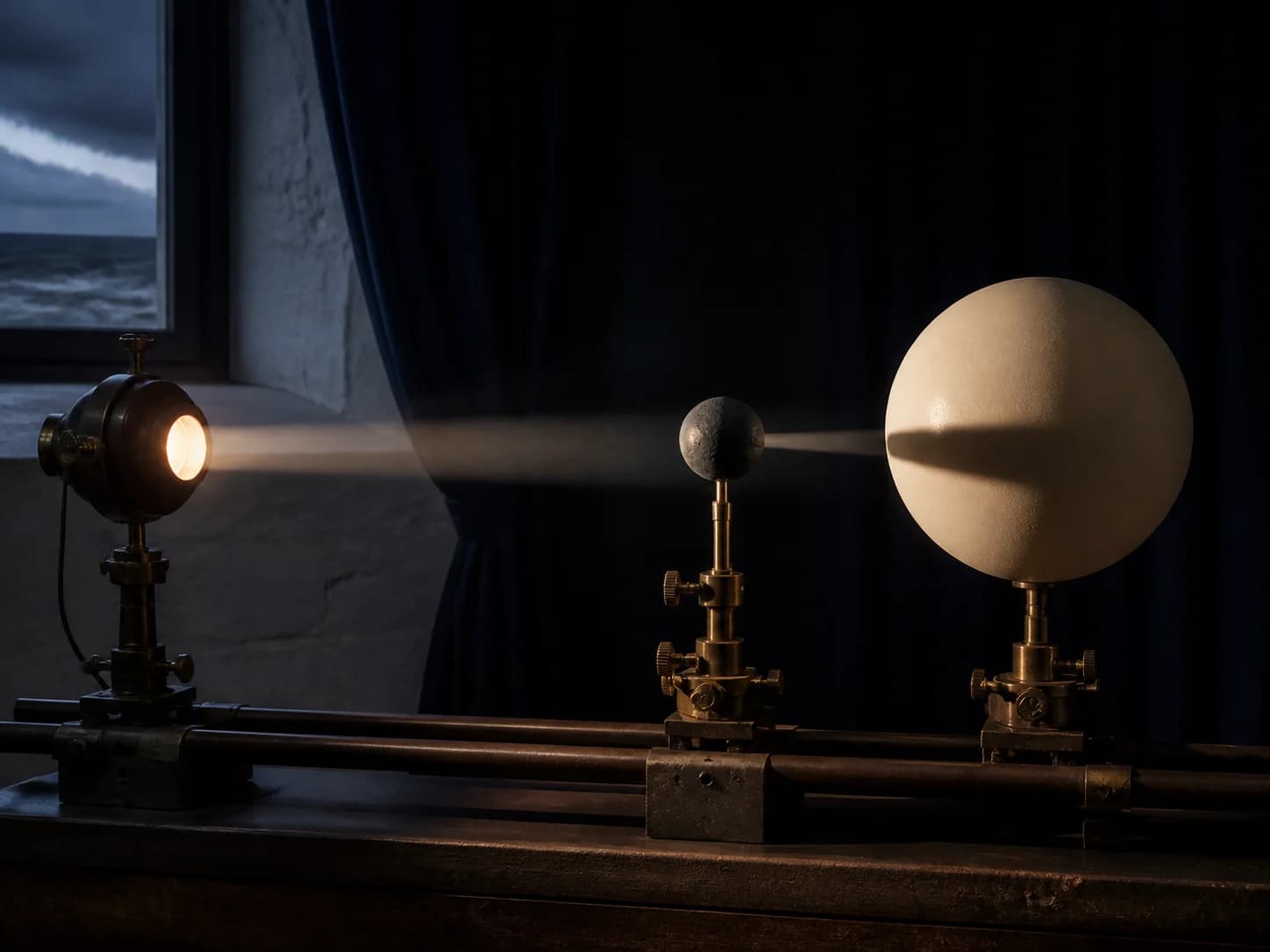
Three eclipse paths through Earth's shadow
Penumbral
The Moon crosses only Earth's outer shadow; umbral obscuration is zero.
Partial
Part of the apparent lunar disc enters the darker umbra.
Total
The full apparent disc enters the umbra and reaches a totality interval.
Contact notation: P1–P4 is the penumbral passage, U1–U4 the umbral passage, and U2–U3 totality.
The event times are global. Open a peak in the position calculator above to check whether the Moon is above your local horizon.